

Net Positive Labs partnered with platform business model experts and a leading European port to ideate, test, and build a new platform business that could address a need in the shipping industry. Together, we built and raised funding for docloop.io, a novel platform, integrating OCR & NLP, to enable rapid and accurate document transfer between different stakeholders in the shipping supply chain.
The client desired to start from a completely blank canvas to identify fresh new opportunities. We organised a series of research and ideation sprints, eventually identifying an opportunity around digital documentation exchange, due to upcoming regulatory changes. We developed initial digital assets (marketing & click dummies) to validate with large B2B clients, eventually refining the model to a platform enabling documentation interoperability. The team developed a platform integrating OCR and training NLP algorithms to effectively effectuate data transfer between different stakeholders shipping systems without the need for manual data input, duplication, or printing.
As a corporate venture, we sourced alternative funding, raising almost €5m from French government grants. The business has been fully spun out, led by an effective CEO, and growing. docloop.io has won awards for its contribution to making the shipping industry more modern and efficient.
Global shipping and logistics underpin international trade, with maritime transport carrying roughly 90% of global trade by volume. Yet despite the scale and sophistication of the industry, many operational processes still rely heavily on manual documentation.
Bills of lading, invoices, customs documentation, and shipping contracts are frequently exchanged between shipping companies, freight forwarders, port authorities, customs agents, and logistics providers. These documents often move between multiple digital systems that cannot easily communicate with each other.
As a result, large amounts of time are spent manually entering, transferring, and verifying information across systems creating inefficiencies, delays, and unnecessary paper consumption across global supply chains.
In collaboration with a leading European port community, opportunities were explored to develop digital platform models that could help accelerate the industry’s transition toward more efficient and interoperable documentation processes.
The shipping ecosystem involves a wide network of stakeholders, each operating their own systems and workflows.
Several structural barriers make documentation management particularly complex:
• incompatible digital systems between logistics stakeholders
• heavy reliance on manual document handling and data entry
• fragmented information flows across the shipping process
• high administrative costs associated with documentation
In many cases, the same information is entered repeatedly across different systems, increasing the risk of errors and delays.
The challenge was therefore to explore solutions that could connect existing systems rather than replace them, enabling documentation to move more seamlessly between stakeholders.
We followed a tradition venture building approach starting with opportunity assessment (from blank canvas), POC testing, and MVP development for market pilots.
DocLoop.io is an independent business with strong external funding and a high performance full time team focusing on growing the business. Docloop has been the recipient of multiple awards for its contribution to addressing a persistent problem in shipping around document transfer.
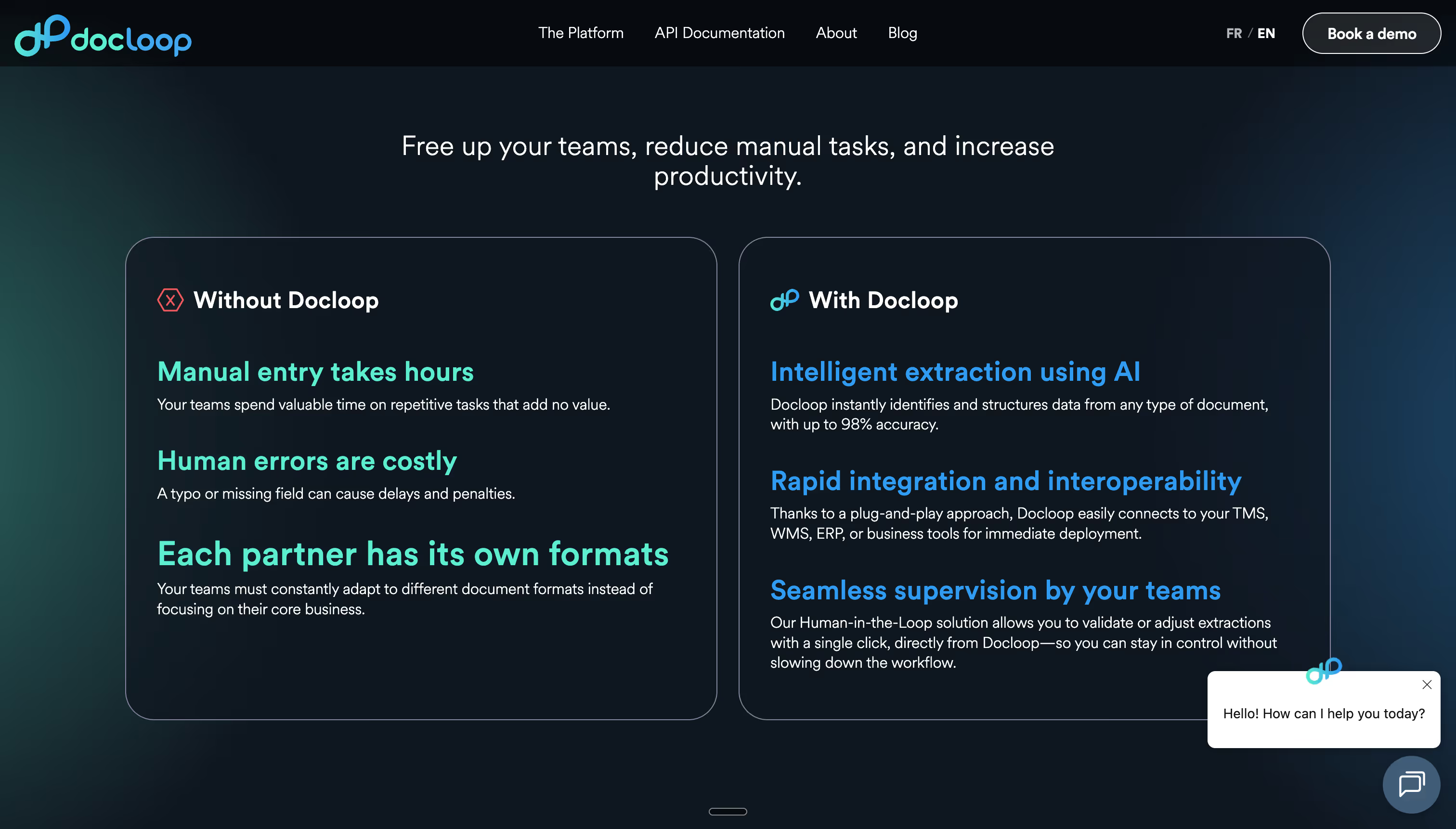
Docloop supports customers by:
• reducing administrative workload
• minimising manual data entry errors
• accelerating information exchange between partners
• reducing the need for paper-based documentation
As global trade continues to expand, improving the efficiency of documentation flows is becoming increasingly important for ports, logistics providers, and shipping companies.
With initiatives such as DocLoop we illustrated how targeted digital platforms can help simplify complex operational processes while improving transparency and interoperability.
Through collaboration between industry stakeholders, technology developers, and venture partners, such solutions can really contribute to a more connected and efficient logistics infrastructure.
.svg)
