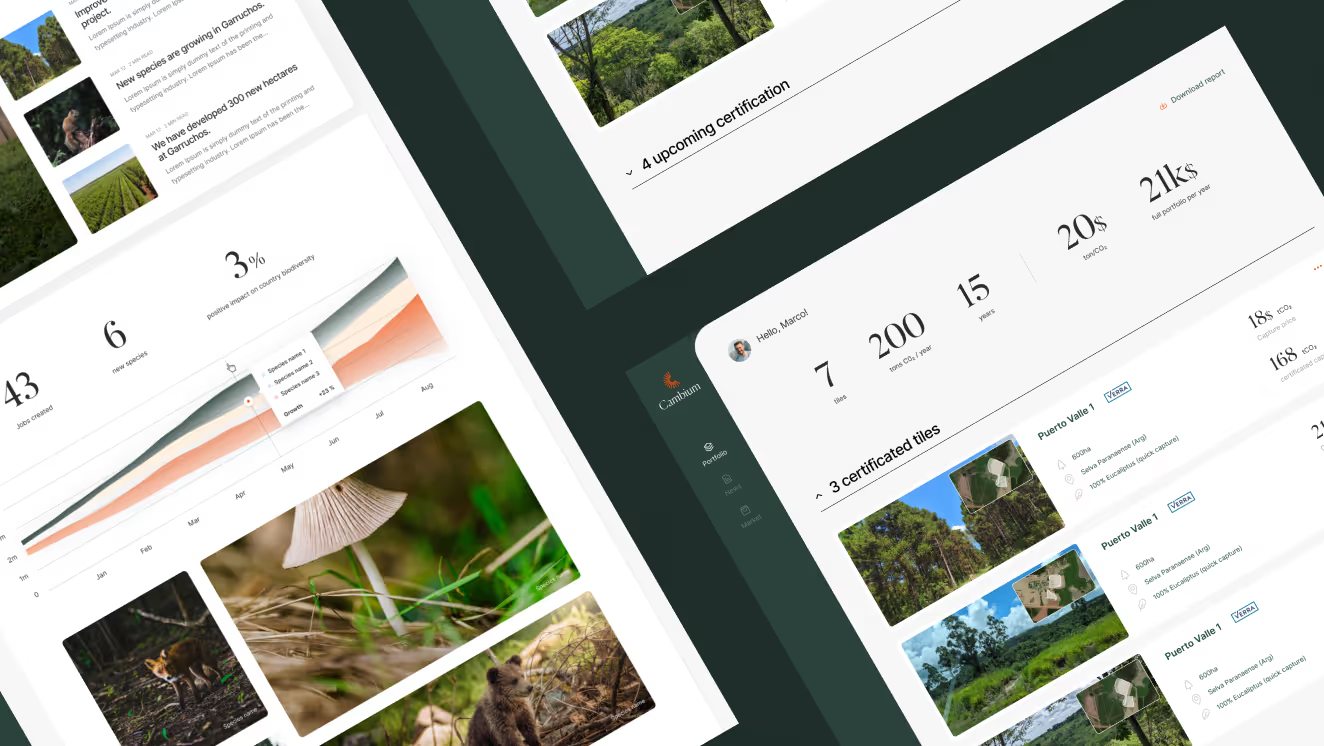

Net Positive Labs supported the early development of a venture building scalable nature-based carbon removal ecosystems that integrate regenerative forestry, agriculture, timber value chains, and carbon markets. Working with the founding team and investor, we helped refine the venture model, shape its narrative, and develop early prototypes and investor materials. The initiative evolved into Cambium, which today develops regenerative land-use projects across Argentina, Paraguay, and Brazil, with more than 3 million trees planted and thousands of hectares under development.
Recent climate science indicates that limiting global warming to 1.5°C is becoming increasingly difficult, and several analyses suggest the world may temporarily exceed this threshold within the coming decades. At the same time, long-term projections show that without accelerated climate action, global temperatures could rise significantly beyond this level.
Despite these challenges, keeping warming as close as possible to the 1.5°C pathway remains essential to avoid the most severe economic, environmental, and societal impacts of climate change. Achieving this will require not only rapid emissions reductions but also large-scale carbon removal at unprecedented scale.
Nature-based solutions, particularly reforestation and regenerative land-use systems, are among the most scalable tools available to remove carbon from the atmosphere while restoring ecosystems, improving soil and water systems, and supporting rural economies.
However, many carbon sequestration initiatives focus narrowly on the generation of carbon credits. This can limit long-term economic viability and fail to capture the broader value that integrated land-use systems can deliver.
As a result, a new generation of climate ventures is exploring integrated land-use models that combine forestry, agriculture, timber value chains, biodiversity restoration, and carbon markets into regenerative ecosystems capable of delivering both environmental and economic outcomes.
At the same time, voluntary carbon markets remain fragmented and immature. Limited transparency, inconsistent methodologies, and insufficient data continue to make it difficult for investors and companies to confidently scale high-quality carbon removal projects.
Forestry-based carbon removal offers one of the most scalable pathways for nature-based climate mitigation. Yet traditional project models face structural barriers:
• fragmented carbon markets and limited transparency
• lack of reliable data on sequestration performance
• complex project development and financing structures
• limited operational capacity among landowners
• insufficient economic incentives for long-term land restoration
At the same time, landowners often require productive economic uses for their land. Carbon sequestration alone rarely provides sufficient financial incentive to drive large-scale adoption.
This creates an opportunity for new models that combine forestry, agriculture, timber value chains and carbon markets into integrated land-use systems capable of generating multiple revenue streams while restoring degraded landscapes.
Such models allow climate mitigation, ecosystem restoration and productive agriculture to coexist within the same landscape; improving both environmental outcomes and long-term project economics.
To explore this opportunity, Insud Pharma supported the development of an initiative focused on building scalable nature-based carbon removal solutions. The initiative formed part of the group’s broader commitment to advancing innovative climate and sustainability solutions.
Net Positive Labs was engaged to contribute its venture-building and sustainability expertise during the early development phase of the initiative.
Working alongside the founding team and investor, the collaboration focused on shaping the foundations of a venture capable of scaling integrated land-use ecosystems. The work included:
• refining the initial venture model and value proposition
• exploring concepts for a data-driven carbon and land-management platform
• developing early prototypes and validation approaches
• supporting early discussions with investors and ecosystem partners
The objective was to help structure the early venture proposition, including core business models, investor materials, and strategic narratives required to position the initiative for funding and further development.
The venture needed to be structured to combine regenerative forestry, agricultural production, timber value chains and carbon markets into scalable land-use ecosystems.
The initiative evolved into Cambium, a company developing large-scale regenerative land-use ecosystems across South America.
Cambium works with landowners and agricultural producers to implement silvopastoral systems, integrating reforestation with livestock operations. This approach allows farmers to restore degraded land while maintaining productive agricultural activity.
Projects typically combine fast-growing tree species for carbon removal with native species that support biodiversity restoration, creating landscapes designed for long-term ecosystem recovery.
The model also enables landowners to generate value through multiple channels, including carbon credits, timber production, and agricultural output.
Cambium complements field operations with a technology platform integrating satellite monitoring, UAV data, LiDAR and AI-based modelling to measure forest growth, track carbon stocks and support MRV processes required for carbon markets.
Today the company operates across Argentina, Paraguay and Brazil, developing nature-based carbon removal projects designed to restore degraded landscapes while expanding global carbon removal capacity.
Impact to date
Early projects illustrate the scale and ambition of this approach:
• More than 3 million trees planted across restoration projects
• Approximately 3,000 hectares under development across South America
• 938,000 trees planted in the Paraná-2 project alone
• Over 1 million tonnes of CO₂ expected to be removed over the lifecycle of Paraná-2
• First project registered under the Verra carbon standard
• Restoration of degraded cattle ranches into regenerative land-use ecosystems
• Integration of native species to enhance biodiversity and ecosystem resilience
These projects demonstrate and prove that regenerative land-use systems can really combine carbon removal, biodiversity restoration, and productive agriculture within a single landscape model.
Marco Bressan, Co-Founder
.svg)
